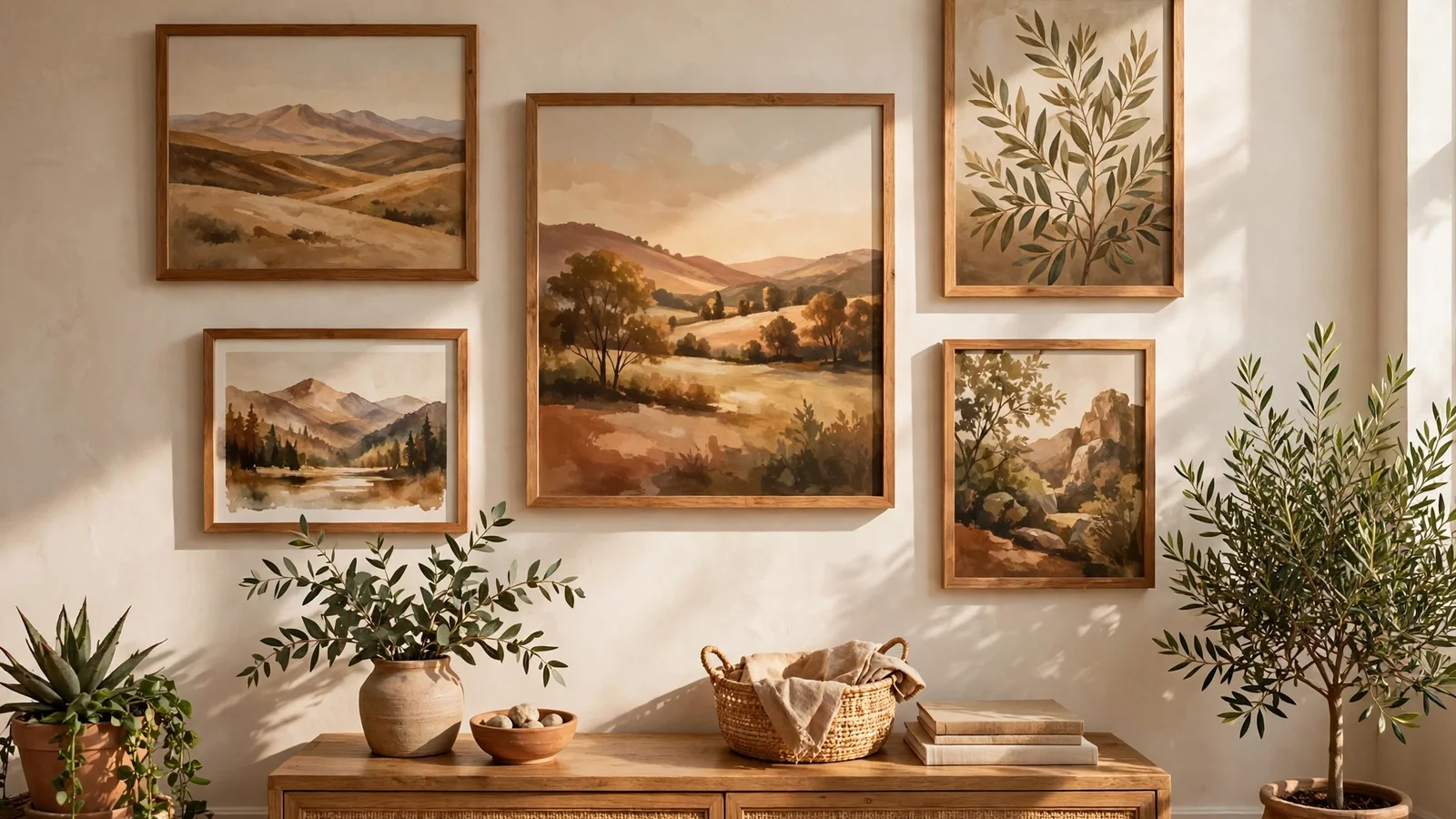
Your walls talk. Every painting in your home is something you look at dozens of times a day, and in Vastu Shastra that repetition matters: the image you live with shapes the mood of the room. A sunrise over the sofa lifts a living room; a stormy sea above the bed does the opposite. This guide covers Vastu paintings and art room by room — what to hang, where to hang it, the famous seven-horses painting, and the art to keep out of your home entirely.
Why art matters in Vastu
Vastu reads a home as a living system: direction, light, the five elements, and the energy of everything placed inside it. Art is one of the easiest levers in that system because it is pure image — no demolition, no renovation, just a frame on a wall. A painting brings its subject's energy into the room: water brings flow, mountains bring stability, flowers bring growth, crowds bring social energy.
That is why the same painting can be right in one room and wrong in another. A waterfall belongs in a living room, not a bedroom. A pair of birds belongs in a bedroom, not an office. The rules below are not superstition for its own sake; they are a consistent logic — match the image to the room's purpose — and once you see the logic, the placements mostly explain themselves.
The five elements in your artwork
Every image can be read through Vastu's five elements. Water (rivers, waterfalls, oceans) brings flow and opportunity — best in the north and north-east. Fire (sunrises, sunsets, red and orange art) brings energy and recognition — best in the south-east. Earth (mountains, fields, pottery) brings stability — best in the south-west. Air (open skies, birds in flight) brings movement and ideas — best in the north-west. Space (open landscapes, empty horizons) brings clarity — best in the centre and north-east.
When a room feels "off" and you cannot say why, check the elements: a fire-heavy painting in a water zone, or a heavy mountain image looming over a study desk, can be the quiet culprit. Our Vastu directions by Mulank guide maps directions to your birth number if you want to personalise this further.
Best paintings for the living room
The living room is where the family gathers and guests are received, so its art should be bright, open and welcoming: sunrise landscapes, flowing rivers, green fields, blooming flowers, joyful family scenes, and art depicting abundance — fruit, harvests, full gardens. Hang the largest piece on the south or west wall so it faces north or east, and keep it at eye level: art hung too high feels distant, art hung too low feels heavy.
The famous seven-horses painting belongs here (or in the office): seven white horses pulling the sun's chariot, symbolising speed, success and unstoppable progress. Hang it on the east or south wall with the horses running toward the inside of the home — never facing the main door, as if the horses are leaving the house. Our Vastu living room guide covers the room's full layout, and our Vastu main entrance guide covers what greets guests at the door.
Bedroom art: calm over drama
The bedroom's purpose is rest and intimacy, so its art should be calm, warm and paired: two birds, a couple, gentle landscapes, soft flowers, moonlit scenes. Avoid single lonely figures, stormy seas, war or hunting scenes, and — the classic mistake — a waterfall above the bed, where flowing water is said to disturb sleep. Keep the palette soft: blues, greens, warm creams. One large calm piece beats a busy gallery wall here.
For couples, Vastu favours images of pairs and togetherness in the bedroom — the visual equivalent of the room's purpose. Our Vastu bedroom guide covers direction, bed placement and colours for the room as a whole.
Paintings for the study and office
A study or home office needs art that focuses rather than distracts: mountains (stability and ambition), an eagle or a rising sun (vision and goals), a calm lake (clarity), or a simple abstract in steady colours. Hang the strongest piece where you can see it from your desk — it should be the first thing your eyes land on when you look up from work.
Avoid art that pulls the eye into restlessness here: busy crowds, chaotic abstracts, and anything depicting conflict. And keep the desk itself clear of visual clutter — the painting is the focus, not a competing poster collection. See our Vastu office and desk guide for the room's full rules.
Entrance art: the first impression
The entrance sets the tone for the whole home, so the art facing the main door should be welcoming and auspicious: a sunrise, a flowering tree, a Ganesha or a pair of birds, a bright landscape. This is the single most visible painting in the house — everyone who enters sees it — so it deserves the best piece you own, not a leftover.
Do not hang mirrors opposite the main door (they are said to bounce incoming energy straight back out), and do not greet visitors with art depicting loneliness, storms, or wild animals. The entrance should say welcome, stay, flourish. Our Vastu plants guide pairs well with this: a tulsi or money plant by the entrance complements the art.
Dining room and kitchen art
The dining room is the room of nourishment and togetherness, so its art should celebrate abundance: fruit bowls, harvests, shared meals, warm family scenes, flowers. A still life of fruit is the classic Vastu dining-room piece for a reason — it pictures exactly what the room is for.
The kitchen, meanwhile, should stay visually light: keep art minimal here, and avoid water imagery near the stove (fire and water clash in Vastu). A small, cheerful piece on a free wall is enough. For the kitchen's full direction and placement rules, see our Vastu kitchen guide.
Art to avoid anywhere in the home
Some images are considered inauspicious in every room, and the list is worth knowing before you buy anything:
| Room | Ideal art | Avoid | Remedy if already hung |
|---|---|---|---|
| Living room | Sunrise, rivers, flowers | War scenes, lonely figures | Move to storage; replace with a landscape |
| Bedroom | Pairs, calm landscapes | Waterfalls, storms, single figures | Move water art to the living room |
| Study / office | Mountains, eagles, rising sun | Chaotic abstracts, conflict scenes | Swap for one focused, steady image |
| Entrance | Sunrise, flowering trees | Storms, wild animals, mirrors opposite door | Rehang facing inward; move mirrors |
| Dining room | Fruit, harvests, shared meals | Empty plates, drought, decay | Replace with an abundance still life |
| Anywhere | Uplifting, bright, complete scenes | Sinking ships, dried trees, weeping figures | Remove; do not store facing a bedroom |
The underlying principle is simple and worth repeating: the image you look at every day shapes the mood of the room. War, weeping, drought and sinking ships are images of struggle — fine in a gallery, but not as the daily backdrop of a home. And never hang a damaged or broken-framed picture: a cracked frame is considered inauspicious and should be repaired or replaced, not lived with.
Colours, frames and placement rules
A few practical rules tie the whole guide together. Placement: hang art at eye level (the centre of the piece roughly 150 cm from the floor), keep the north-east corner light and open, and never hang a heavy piece directly above a bed or a desk chair. Colours: warm earth tones suit the south-west, blues and greens suit the north and east, and bright reds and oranges belong in the south-east — use colour the way the room's element map suggests.
Frames: wood frames suit most rooms, metal frames suit the west and north-west, and heavy dark frames are best avoided in the north-east. And quantity: one strong piece per wall beats a crowded gallery in Vastu — the wall needs breathing room for the image to work.
Hanging art in rented homes and small spaces
Renters and small-home owners get the same benefits with lighter methods. Command strips and leaning frames (a large piece leaned against a wall on a shelf or console) give you the image without drilling; a single well-chosen canvas can carry a whole room. In a studio or one-room home, use art to define zones: a calm piece marks the sleep corner, a mountain or sunrise marks the work corner.
Small spaces also benefit most from the "one strong piece" rule — clutter is the enemy of Vastu in a small home, and a crowded wall is clutter. If you are choosing between rooms, start with the living room or the entrance: they set the tone for everything else. For the number your home itself carries, our house number numerology guide is a useful companion read.
Vastu paintings & art: frequently asked questions
Which painting is best for the living room as per Vastu?
For the living room, Vastu favours bright, uplifting art: sunrise landscapes, flowing rivers, green fields, blooming flowers, and joyful family scenes. Hang the largest piece on the south or west wall so it faces north or east. Avoid lonely figures, war scenes, and images of drought or decay in the room where guests gather.
Can I hang a waterfall painting at home?
Yes — a waterfall painting is considered auspicious in Vastu when the water appears to flow into the home, not out of it. Hang it on the north or north-east wall of the living room, with the water flowing toward the centre of the room. Avoid waterfall art in the bedroom, where flowing water is said to disturb rest.
Are Buddha paintings good for Vastu?
Buddha paintings are considered good for Vastu when placed with respect: a calm, meditating Buddha suits the living room, study or meditation corner, ideally facing east or north-east. Avoid placing Buddha images in the bathroom, kitchen, or on the floor, and avoid a reclining Buddha in the bedroom.
Where should I hang a seven-horses painting?
The seven-horses painting — seven white horses pulling the sun's chariot — is traditionally hung in the living room or office, on the east or south wall, with the horses running toward the inside of the home. It symbolises speed, success and unstoppable progress. Never hang it facing the main door, as if the horses are leaving the house.
Which paintings should be avoided at home as per Vastu?
Vastu advises avoiding art that depicts war, violence, weeping or lonely figures, wild animals in attack, dried or withered trees, sinking ships, and dark, stormy scenes — especially in the bedroom and living room. The principle is simple: the image you look at every day shapes the mood of the room, so choose images that lift it.
Does the frame material matter in Vastu?
Frame material matters less than placement, but Vastu tradition prefers natural materials: wood frames suit most rooms, metal frames suit the west and north-west, and heavy dark frames are best avoided in the north-east. Keep frames clean and undamaged — a cracked or broken frame is considered inauspicious and should be repaired or replaced.
Hang what lifts the room
You do not need a renovation to change how a home feels — sometimes one painting, hung in the right place, does it. Start with the room you spend the most time in, choose one image that lifts it, and hang it where your eyes naturally rest. If you want a full Vastu reading of your home — directions, rooms and remedies tuned to your birth numbers — a personal Vastu consultation can map it room by room. You can reach out here to begin.
Get new readings in your inbox
One short email when a new angel-number guide or calculator goes live. No spam, ever.
Not sure what your walls are saying?
Get a room-by-room Vastu reading of your home, tuned to your birth numbers.
Book a Consultation