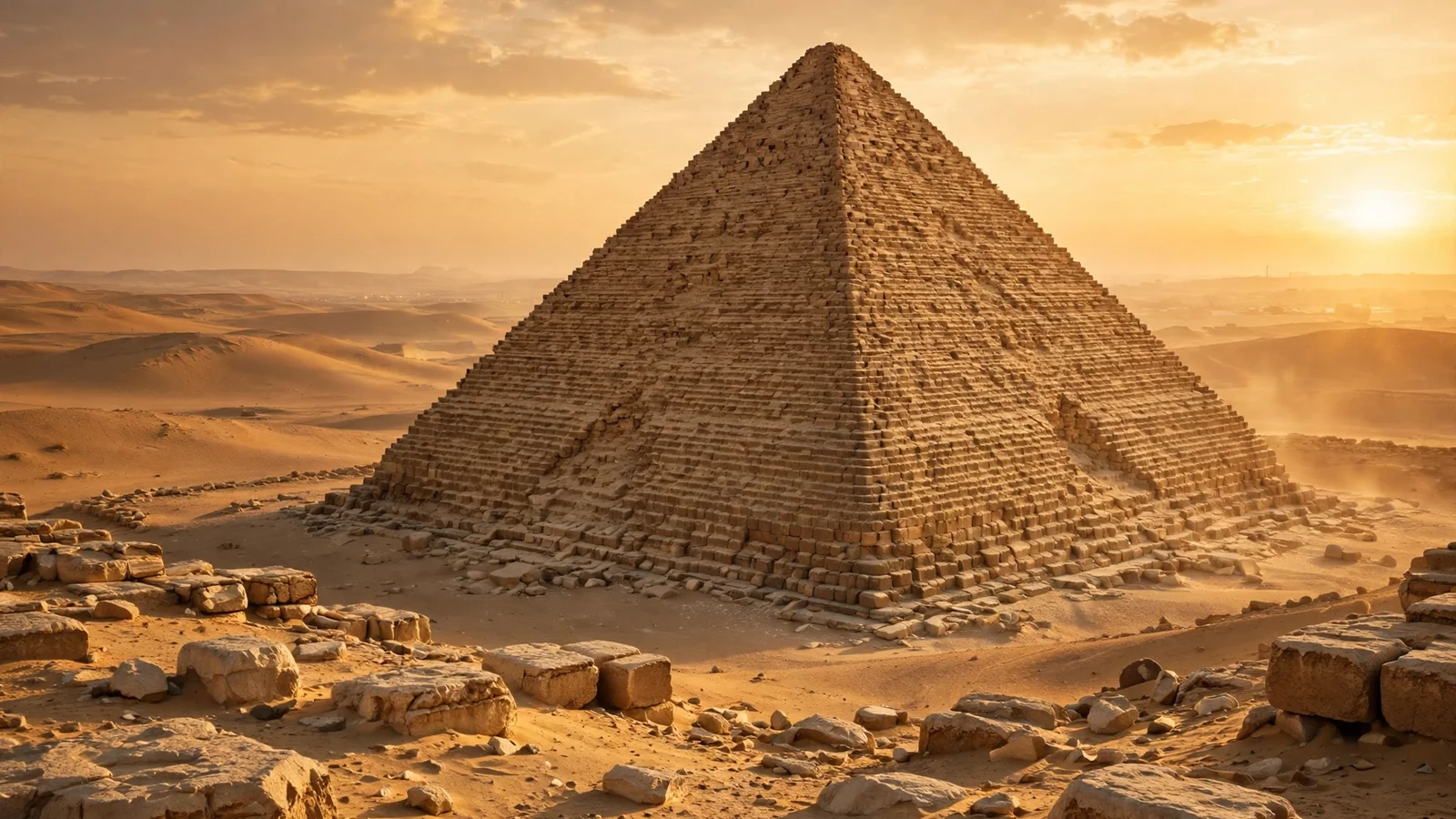
Every pyramid you will ever sit under — copper, brass, or cardboard — is a small echo of one building: the Great Pyramid of Giza. Built around 2560 BCE, it is the oldest of the Seven Wonders of the Ancient World and the only one still standing. It is also the reason the pyramid shape carries the meaning it does today: precision, endurance, and a geometry that seems to point beyond itself. Here is the history of the Great Pyramid — what we know, what we still argue about, and what modern pyramid energy practice borrows from it.
The Great Pyramid in numbers
The scale is hard to hold in the mind, so here it is plainly. The Great Pyramid was built for Pharaoh Khufu during Egypt's Fourth Dynasty, around 2560 BCE. It originally stood about 146.6 metres tall (481 feet) — the tallest human-made structure on Earth for more than 3,800 years — and each side of its base measures about 230 metres. It contains roughly 2.3 million stone blocks, most weighing 2.5 tonnes, some (in the King's Chamber) weighing up to 80 tonnes. Its total mass is around 5.9 million tonnes.
It was originally clad in smooth white Tura limestone that would have gleamed in the desert sun; a gold or gilded capstone, the pyramidion, may have crowned it. The casing was stripped away over centuries for other building projects, leaving the stepped core we see today. It is, by any measure, the largest pyramid ever built — and it was built without iron tools, without the wheel for heavy transport, and without anything resembling a crane.
How was it built? The honest answer
The honest answer is: we know the broad strokes and argue about the details. The mainstream account, supported by workers' villages, quarries, harbours and tools found at Giza, is that a large, organised workforce of skilled labourers — not slaves — built the pyramid over 20 to 30 years, roughly the length of Khufu's reign. Seasonal crews of farmers worked during the Nile flood, when fields were underwater; a permanent core of stonemasons, engineers and overseers worked year-round.
The blocks were quarried locally, dragged on sledges over wet sand (a technique confirmed by experiment and by ancient depictions), and hauled up ramps. Which ramps, exactly, is the open question: straight ramps, zigzag ramps, a ramp spiralling around the pyramid, or internal ramps have all been proposed, and evidence supports elements of more than one theory. The 2013 discovery of the Diary of Merer — a logbook kept by an inspector moving limestone by boat — confirmed the vast logistics: stone arriving by river, teams working in named gangs, supplies moving on a schedule. The pyramid was, above all, a project of organisation.
The pyramid's precise alignment and measurements
Here is where the building earns its reputation for mystery. The Great Pyramid is aligned to true north with an error of only about 3/60 of a degree — more accurate than many modern buildings. The builders most likely set this by observing the stars, tracking circumpolar stars or the rising and setting points of a chosen star. Its base is almost perfectly level, and its four sides are nearly identical in length, differing by only a few centimetres over 230 metres.
The numbers invite speculation, and some of it is genuinely striking: the ratio of the pyramid's perimeter to its height is close to 2π; the base sits very near the 30th parallel north. Some of these relationships fall out naturally from the pyramid's slope (a seked of 5½ palms), and some may be coincidence. What is not coincidence is the care: this level of precision, sustained over millions of blocks, reflects a building that was meant to be cosmically correct, not merely large. In Egyptian belief, the pyramid was a stairway and a machine of rebirth — its alignment was part of its function.
The King's Chamber, the Queen's Chamber, and the Grand Gallery
Inside, the pyramid is a small system of passages and rooms, not a hollow monument. The Grand Gallery is the most impressive interior space: a corbelled corridor 47 metres long and 8.6 metres high, rising at 26 degrees toward the King's Chamber. The King's Chamber holds a red-granite sarcophagus (empty when found) and is roofed by five layers of massive granite beams — relieving chambers stacked above it to spread the weight of the pyramid itself. The so-called Queen's Chamber was probably not for a queen at all; its purpose remains debated.
Two narrow shafts run from the King's Chamber to the outside — the "air shafts" — and their alignment with stars (Orion's belt, Sirius) is one of the details that keeps the pyramid in the realm of the cosmic. In 2017, the ScanPyramids project detected a large void above the Grand Gallery, roughly 30 metres long; its purpose is still unknown, and it may be a structural gap rather than a hidden chamber. The pyramid is still giving up secrets.
The mysteries that won't go away
Three questions keep returning, and each deserves an honest answer rather than a dismissive one.
Could the builders really have done it with Bronze Age tools? Yes — slowly, with enormous labour, and with techniques we can replicate. Experiments have cut and moved multi-tonne blocks with copper tools, wooden sledges and wet sand. The difficulty was never any single block; it was sustaining the effort for decades.
Is the pyramid aligned with Orion's belt? The three pyramids of Giza roughly match the three stars of Orion's belt, and the match is close enough to be suggestive but loose enough to be debated. The Orion Correlation Theory remains a theory, not a settled fact — but the Egyptians certainly associated Orion with Osiris and rebirth, so a celestial reference is plausible in spirit.
Why does the shape feel meaningful? This is the question that matters most for our purposes. A pyramid is a shape that gathers a wide base into a single point — it is, geometrically, a picture of focus. Whether or not the Egyptians intended any "energy" effect, the shape itself has carried that symbolism for four and a half millennia, and modern practice inherits it.
Pyramid power: the 20th-century energy experiments
The modern idea of "pyramid power" dates to the 1930s, when French radiesthesist Antoine Bovis claimed food stayed fresh inside a small pyramid, and it exploded in the 1970s with claims that razor blades stayed sharp, plants grew faster, and meditation deepened under pyramid shapes. These claims have not held up under controlled testing — blades do not stay sharp, and food does not keep better, in any way a laboratory can measure.
What has held up is the experience people report: sitting under a pyramid, in stillness, with the shape above you and the world shut out, reliably feels different from sitting in an open room. Whether that is geometry, symbolism, or simply the effect of a dedicated quiet space is, for a practitioner, almost beside the point — the practice works by giving attention a shape to rest on. Our guide to what pyramid energy is separates the testable claims from the traditional ones, and our choosing a meditation pyramid guide covers sizes and materials for home use.
What modern pyramid meditation borrows from Giza
Modern pyramid meditation is not a reconstruction of Egyptian practice — the chambers were tombs, not meditation halls — but it borrows four things from Giza, and each is worth naming:
| From Giza | What it is | How modern practice uses it |
|---|---|---|
| Cardinal alignment | One face to true north | Pyramids are placed with a face to the north for meditation |
| The 51.8° slope | The Great Pyramid's angle | Most meditation pyramids copy this slope |
| The apex as focus | Wide base rising to one point | Sitting beneath the apex as a point of attention |
| Stillness & enclosure | Sealed stone chambers | A quiet, dedicated space set apart from daily life |
That last borrowing is the most practical one. The Egyptians built a space set apart from the world; a meditation pyramid does the same thing at the scale of a room. If you meditate with others, our group pyramid meditation guide covers seating, group size and etiquette, and our pyramid meditation postures guide covers how to sit inside one comfortably.
Visiting Giza: what to know
If the history makes you want to see it in person, Giza rewards the trip — with a few practical notes. The plateau is open daily; the Great Pyramid itself can be entered, but only a limited number of visitors per day, and the interior is hot, narrow and steep — not for the claustrophobic. The Grand Egyptian Museum, which opened near the plateau, now holds the full context: the treasures, the tools, the workers' story. Go early, before the heat and the crowds, and budget half a day at minimum. The Sphinx, the second pyramid of Khafre (which still wears some of its original casing at the top), and the solar boat museum are all on the same plateau, and together they give the full picture of what a royal necropolis was.
Giza and your own pyramid practice
You do not need a 146-metre monument to use what Giza teaches. A small copper pyramid on a desk or a full-size meditation pyramid in a corner borrows the same four things: alignment, slope, apex, stillness. Keep it clean — our copper pyramid care guide covers cleaning and maintenance — keep it aligned with a face to the north, and keep the space around it uncluttered. The shape does the symbolic work; your attention does the rest.
And if you are choosing between a pyramid and another energy tool, our pyramid vs orgonite comparison lays out the differences honestly. The right tool is the one you will actually sit with.
The pyramid's lesson for modern life
The Great Pyramid was built by people who expected it to last forever, and it nearly has. Its lesson is not mystical — it is practical: big things are built by small, repeated, organised effort, sustained for a very long time. Two million blocks, one at a time, for decades. That is also, incidentally, how a meditation practice is built, and how any serious life change happens. The pyramid is a monument to patience as much as to power.
Pyramid history: frequently asked questions
How old is the Great Pyramid of Giza?
The Great Pyramid was built around 2560 BCE, during the reign of Pharaoh Khufu, making it roughly 4,500 years old. It is the oldest of the Seven Wonders of the Ancient World and the only one still standing.
Who built the Great Pyramid?
It was built by Egyptian workers — skilled labourers, stonemasons and seasonal crews — not slaves, according to modern archaeology. Workers' villages, bakeries and cemeteries found near Giza show a large, organised, well-fed workforce. The pyramid was a tomb for Pharaoh Khufu.
How long did it take to build the Great Pyramid?
Most estimates put construction at 20 to 30 years, roughly matching the length of Khufu's reign. Around 2.3 million stone blocks were placed — an average of roughly one block every few minutes during working hours, sustained for decades.
Why is the Great Pyramid aligned to true north?
The Great Pyramid is aligned to true north with an error of only about 3/60 of a degree — more accurate than most modern buildings. The builders likely used the stars, probably by tracking the circumpolar stars or the rising and setting of a star, to set the alignment. The precision reflects the pyramid's role as a cosmic and religious structure, not just a tomb.
What is pyramid power?
Pyramid power is the 20th-century idea that the pyramid shape concentrates or focuses energy — popularised by claims that razors stay sharp, food stays fresh, and meditation deepens inside pyramid shapes. These claims are not supported by controlled scientific evidence, but the shape remains widely used in meditation practice, where practitioners report deeper focus and calm.
Can I meditate like the Egyptians did?
We do not know exactly how Egyptians meditated inside pyramids — the chambers were tombs, not meditation halls. Modern pyramid meditation borrows the shape and the symbolism: sitting under a pyramid aligned to the cardinal directions, in stillness, for 15 to 30 minutes. Start with our guide to pyramid meditation for beginners and choose a pyramid sized for your space.
Four thousand years later, the shape still speaks
The Great Pyramid has outlasted the civilisation that built it, the religions that followed, and every empire since. It endures because it was built with care that bordered on obsession — and because its shape still means something to anyone who stands beneath it: a wide base, a single point, and the long, patient climb between them. If you want to bring a little of that into your own practice, start with our pyramid energy guide, and if you would like personal guidance on choosing or using a pyramid, you can reach out here.
Get new readings in your inbox
One short email when a new angel-number guide or calculator goes live. No spam, ever.
Want to bring pyramid energy into your own practice?
Get personal guidance on choosing, placing and using a pyramid for meditation and your home.
Book a Consultation